Hydrofluorocarbons — now the dominant refrigerants in billions of cooling systems worldwide — are super pollutants with global warming potentials hundreds to thousands of times greater than CO2. While the Kigali Amendment has set the world on a path to phase down their production and consumption, two critical gaps remain: the massive stockpile of refrigerants already in use, and the uneven road ahead in transitioning to lower-impact alternatives. This post explores how lifecycle refrigerant management can help close those gaps — and why it represents one of the most immediate, cost-effective climate wins available today.
Introduction
As Cascade expands into super pollutant mitigation, our initial program will focus on refrigerants — encompassing both lifecycle refrigerant management and the transition to next-generation alternatives. This first blog in a series explores lifecycle refrigerant management — why it matters, what's blocking progress, and how strategic interventions can unlock immediate climate wins and build economic resilience.
Cascade is far from the first to call attention to the importance of lifecycle refrigerant management in tackling climate change. A range of organizations — such as Carbon Containment Lab, Climate and Clean Air Coalition, Environmental Investigation Agency, Institute for Governance and Sustainable Development, Natural Resources Defense Council, and numerous others — have been doing great work in this space for many years. Yet beyond this dedicated community, the scale and urgency of refrigerant emissions remain underappreciated in mainstream climate discourse.
Cascade aims to complement the work of partner organizations by engaging deeply in a subset of developing countries with the potential to get lifecycle refrigerant management on a much stronger trajectory in the coming years. We see an opportunity to mobilize catalytic private and public finance to deliver immediate mitigation while building a bridge toward large-scale policy and industry action needed to embed lasting accountability for refrigerant emissions reductions.
The Role of Refrigerants in Climate Change
Refrigerants are the chemicals used in cooling systems that absorb heat from a space and release it elsewhere through continuous phase changes. These working fluids are used in all heat pump systems, from your car’s air conditioner and your supermarket’s refrigerated cases, to your home’s heat pumps that provide both cooling and heating.
For decades, chlorofluorocarbons (CFCs) and hydrochlorofluorocarbons (HCFCs) served as our primary refrigerants. While effective at cooling, emissions of CFCs and HCFCs during equipment use, servicing, and at end of life led to the depletion of the stratospheric ozone layer which protects against harmful UV rays. The 1987 Montreal Protocol — ratified by 197 countries — phased out the production and use of these ozone-depleting substances in what became a global environmental success story. The ozone layer has shown notable recovery as a result, though CFCs and HCFCs still remain in some existing equipment and cylinder stockpiles around the world.
Unfortunately, the refrigerants that replaced the ozone-depleting substances (ODS) perpetuated another environmental challenge: climate change. Both the legacy ozone-depleting substances and the primary replacement refrigerants, hydrofluorocarbons (HFCs), are potent greenhouse gases considered to be “super pollutants.” On a ton-for-ton basis, HFCs have global warming potentials (GWPs) hundreds to thousands of times greater than carbon dioxide (CO2), meaning even small quantities leaked into the atmosphere create outsized climate impacts.
HFCs also have a relatively short atmospheric lifetime compared to CO2 — 15 years on average versus centuries for CO2. This means their warming impact is concentrated over a shorter period, while CO2 accumulates and persists in the atmosphere for much longer. Mitigating HFC emissions now, therefore, delivers rapid climate benefits within decades, complementing the CO2 reduction and removal strategies essential for limiting long-term warming.
The Kigali Amendment and Two Critical Gaps
In 2016, the Kigali Amendment to the Montreal Protocol was adopted to phase down the production and consumption of HFCs due to their contribution to climate change. The Kigali Amendment will drive a transition from HFCs to next-generation refrigerants with much lower GWPs.
Full implementation of the Kigali Amendment is projected to avoid between 33 and 47 GtCO2e emissions cumulatively by 2050. For comparison, this is equivalent to shutting down every coal-fired power plant in the world for 3.5 to 5 years (IEA). This represents a major win for climate. However, two critical challenges remain unaddressed: 1) the “installed refrigerant bank” problem and 2) implementation risks in the transition to alternative refrigerants.
Gap 1: The “Installed Refrigerant Bank” Problem
First, neither the Montreal Protocol nor the Kigali Amendment adequately address the global “installed refrigerant bank” — the massive quantity of higher-GWP refrigerants already contained in existing equipment and cylinder stockpiles. The scale is staggering: estimates suggest there are between 16 Gt CO2e and 24 Gt CO2e of ODS and HFC refrigerants currently in existence, with an additional 67 Gt CO2e projected to enter the market through 2100 even with full Kigali Amendment implementation.
The installed bank problem will intensify as rising temperatures and economic growth drive unprecedented cooling demand. Southeast Asia alone is projected to see a ninefold increase in air conditioners between 2020 and 2040. In the near-term, the refrigerants used in new equipment installations will be predominantly HFCs, especially in developing countries (referred to as Article 5 countries under Kigali) where phase down schedules allow more time for technology transition. Each HFC system installed today locks in decades of potential emissions.
Currently, there is little to no incentive for equipment owners and service technicians to prevent refrigerant leaks during equipment use or venting at end-of-life. Leakage from existing, in-use equipment is widespread, as refrigerants escape through deteriorating seals, gaskets, joints, and micro-cracks in tubing. Although venting of ODS and HFCs is explicitly illegal in many countries during servicing and at end-of-life, compliance has proven difficult to monitor and enforce. From an economic standpoint, recovering refrigerant typically poses a net cost to technicians: it can be time-consuming, requires specialized equipment, and there are limited markets for recovered refrigerants.
Gap 2: Implementation Risks in the Transition to Alternative Refrigerants
Secondly, countries may struggle to meet their Kigali HFC phase-down obligations primarily due to a lack of available, scalable low-GWP alternatives across a wide range of use cases. The Montreal Protocol succeeded in part because replacement was straightforward — HFCs could substitute for CFCs and HCFCs across most applications without significant system modifications.
Today's transition away from HFCs is structurally different, creating a much bumpier road with ongoing risk of setbacks and delays. While low-GWP refrigerants have proven technically viable in specific use cases, they have not yet achieved the broad and immediate usability that made HFCs effective universal replacements. Adoption of low-GWP alternatives across residential and commercial sectors faces technical, economic, and capacity barriers — issues that are particularly acute in Article 5 countries that are dependent on foreign supply of refrigerants and equipment.
These barriers include:
High upfront costs: Ultra-low GWP refrigerants — natural refrigerants and hydrofluoroolefins (HFOs) — are not drop-in replacements for HFCs, requiring entirely new system configurations and significant capital expenditure. Production capacity of both next-generation equipment and refrigerants must scale dramatically to drive costs down, requiring industry-wide investment and commitment.
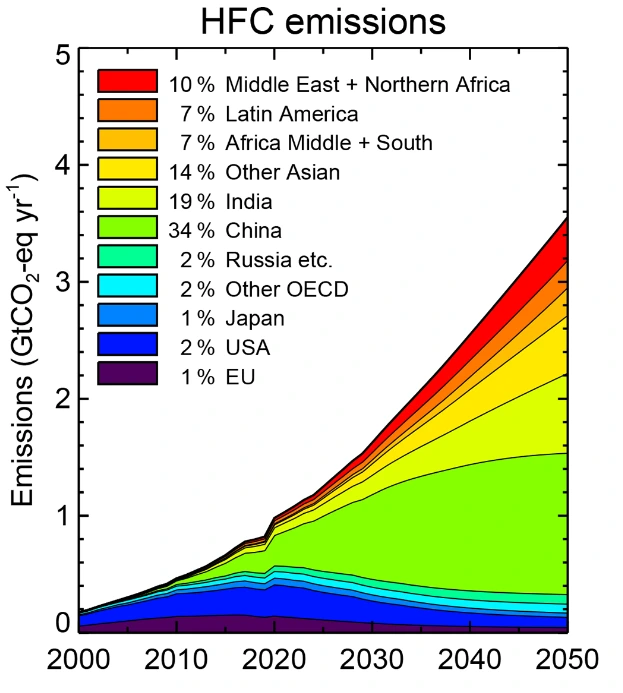
Supply chain vulnerabilities: China currently produces about 70% of the world's HFCs, and fast-rising cooling demand combined with Kigali Amendment phase down implementation is likely to strain supply chains, trigger price volatility or, if enforcement is weak, increase illegal production and trade.
Technical capacity gaps: A limited pool of trained technicians and insufficient technical capacity across much of the supply chain constrains the ability to safely install, maintain, and service next-generation refrigerants.
Safety concerns: Many natural refrigerants (particularly hydrocarbons) are highly flammable, requiring building and fire code revisions, specialized equipment, and extensive technician training programs before they can be deployed at scale.
Industry resistance: Manufacturers often promote intermediate options (HFO/HFC blends, R-32 with GWP of ~675) rather than ultra-low GWP natural refrigerants or pure HFOs, slowing the transition to the most climate-friendly alternatives.
Environmental impacts of some HFC replacements: There is growing concern that HFOs are a source of per- and polyfluoroalkyl substances (PFAS) pollution as they break down in the atmosphere. These “forever chemicals” have been found in water and food sources, raising concern that HFO adoption is simply moving from one F-gas environmental contaminant to another.
The Kigali Amendment established thoughtful phase-down schedules with strong global buy-in that will yield significant HFC emissions reductions; yet implementation risks remain. The complexity of the HFC transition requires a wide array of solutions to address the barriers outlined above. Significant financial investment by governments, manufacturers, technicians, and other stakeholders is required to enable full Kigali adoption. With limited transition finance from sources like the Multilateral Fund and World Bank relative to required investment scale, these challenges create concrete risks of delayed implementation and prolonged HFC reliance.
How Lifecycle Refrigerant Management Addresses Gaps
Lifecycle refrigerant management (LRM) — the systematic mitigation of refrigerant emissions across equipment lifecycles — addresses aspects of both gaps in the Kigali Amendment's scope. The potential for impact is substantial: LRM could mitigate 39 Gt of CO2e HFC and ODS emissions between 2025 and 2050. At roughly 1.5 Gt CO2e annually, this is comparable in scale to other high-priority superpollutant interventions such as methane capture at landfills.
Addressing Gap 1: LRM as the Solution to the Installed Refrigerant Bank
LRM is the only viable approach to address the existing installed bank of refrigerants. Without proper LRM, virtually all HFC and ODS refrigerants currently in use, or yet to be deployed, will eventually leak or be vented to the atmosphere.
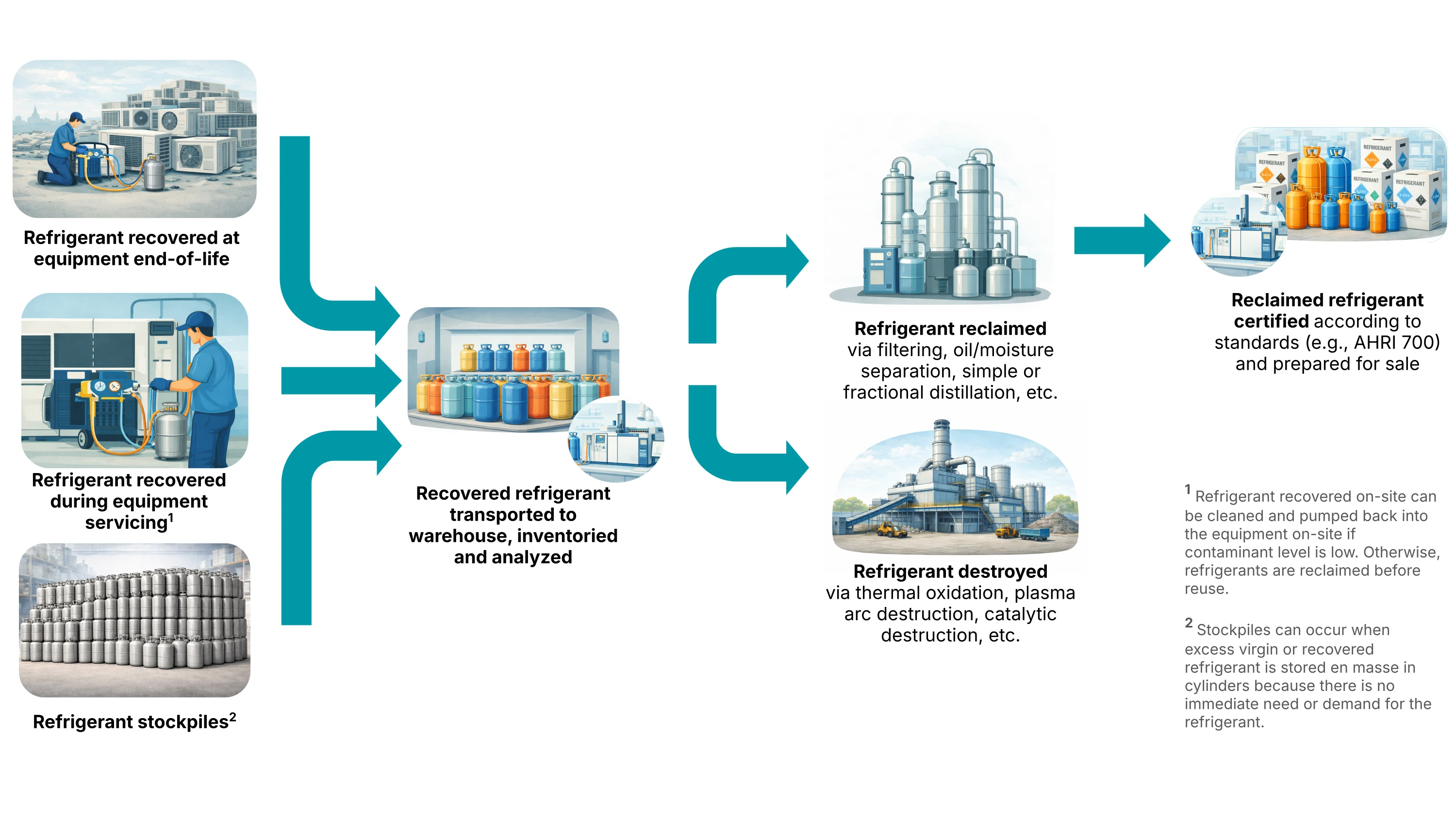
LRM encompasses four core interventions to prevent emissions across the equipment lifecycle:
Leak reduction through improved system design, proper installation, maintenance and monitoring during operation lifetime of cooling equipment.
Recovery of refrigerants during equipment servicing and at end-of-life, preventing intentional or accidental atmospheric venting.
Reclamation of recovered refrigerants to quality standards, enabling reuse in other equipment which decreases demand for virgin refrigerant production.
Destruction of recovered refrigerants for which there is little or no reuse potential through high-temperature incineration or other approved methods, permanently eliminating their direct climate impact.
By managing refrigerants across the complete equipment lifecycle, LRM prevents the vast majority of installed bank emissions that would otherwise escape during routine use, maintenance, and eventual retirement.
Figure 1: Refrigerant management value chain
Refrigerant Recovery: The Foundation for Successful LRM
Efficient, cost-effective recovery of refrigerants during servicing and at end-of-life is the foundation of lifecycle refrigerant management. Recovery infrastructure — trained technicians, specialized equipment, collection networks, and logistics systems — enables all downstream LRM strategies. Whether recovered refrigerants are reclaimed or destroyed, recovery capacity must be built first. Investment in this infrastructure today is therefore critical for scaling LRM in the years to come.
Addressing Gap 2: LRM as a Bridge for Refrigerant Transition
While LRM cannot solve the full range of refrigerant transition barriers, it can help smooth critical economic aspects of the shift. Both reclamation and destruction help manage the existing HFC stock while accelerating the shift to low-GWP alternatives—reclamation by creating transition flexibility and resilience, and destruction by creating market pull for new refrigerants.
Domestic reclamation capacity can help Article 5 countries mitigate the bumpy transition path by maintaining a buffer supply of HFCs to service existing equipment. Under Kigali, reclaimed refrigerants don't count toward consumption caps. This provides an avenue for countries to establish more self-reliance and resilience during a long stretch of accelerating domestic demand and foreign supply prone to disruption and price instability. Reclaimed HFCs can absorb demand while reducing exposure to international spot prices, dependence on a small set of foreign producers, and incentives to buy low-quality product via gray markets—all without eating into tightening import quotas.
However, there is a real risk of over-investing in reclamation: establishing highly profitable systems around declining HFCs could create perverse incentives to prolong their use. HFC reclamation works best as a time-limited buffer during technology transition, not as a dominant refrigerant supply strategy.
Meanwhile, destroying HFCs recovered from end-of-life equipment will gradually increase the market demand for low-GWP alternatives in new and replacement systems as the HFC production phase down progresses. This demand signal will motivate equipment and chemical manufacturers to scale up existing low-GWP technologies and develop new ones where necessary, expanding access to consumers in Article 5 countries. At the same time, it's important that destruction efforts are ramped up gradually over time to prevent HFC refrigerant price shocks that could restrict access to critical cooling equipment.
Faster phase-down may be less costly long-term by accelerating equipment turnover to efficient low-GWP systems. This is why recovery infrastructure must ultimately prioritize HFC destruction as the end state, with reclamation serving as a time-limited bridge.
Current State and Path Forward
Global leaders in LRM illustrate both the promise and limits of existing policy approaches. Japan and Australia rank among the strongest performers globally, achieving recovery rates of over 40% and 35-61%, respectively, through comparatively robust regulations and infrastructure development support. Yet, even in these best-in-class jurisdictions, where comprehensive LRM policy frameworks exist, refrigerant recovery has not become the default behavior for all equipment operators and technicians. Even these leaders have meaningful headroom to drive recovery rates higher.
Leading countries remain the exception rather than the rule. The global baseline is far lower — meaning recovery is severely under-incentivized nearly everywhere. The result is a significant and largely untapped climate opportunity: globally, the vast majority of high-GWP refrigerants continue to be leaked, vented, or lost during equipment disposal rather than responsibly recovered.
From Opportunity to Action
Lifecycle refrigerant management represents a rare convergence: a climate intervention that is highly cost-effective and immediately deployable, while also strengthening economic resilience and enabling the rapid, equitable expansion of cooling in a warming world.
As we build our refrigerant program at Cascade, we're focusing on strategic interventions that can catalyze systemic change — particularly in import-dependent developing countries experiencing fast-growing demand and acute transition challenges. In our next blog post, we'll share how Cascade is approaching this work: our focus on engagement in particular Article 5 countries, our strategy for unlocking catalytic finance, and the design principles that ensure early projects lead to lasting policy and industry action.
We are deeply grateful to Gabrielle Dreyfus (Institute for Governance & Sustainable Development) and Anastasia O'Rourke (Carbon Containment Lab) for generously sharing their time and expertise in reviewing this blog, and to Eric Ripley (A-Gas) and Louis Potok (Recoolit) for contributing practitioner insights on the refrigerant management value chain figure. Their feedback does not constitute endorsement of the views expressed herein.
Footnotes
In 2024, global coal generation reached 10,700 TWh. Coal power typically emits ~1 tonne CO2/MWh meaning total emissions from coal power was ~10.7 GtCO2 that year.
 Cascade Climate